Agentic Sales Operations: From Lead Research to Reviewed CRM Updates
A practical research-to-CRM workflow with field-level evidence, controlled updates and an honest distinction between faster preparation and better sales outcomes.
Read the articleAgentic AIWorked example
A worked example of the business case for an AI agent: count review and exceptions, separate capacity from cash savings, and measure the whole process.
ABOUT THE EVIDENCEThe financial example and sensitivity charts are illustrative calculations, not a customer case study. External research is attributed and its limits are stated.
An agent prepares an invoice in forty seconds. A person previously spent twenty-four minutes on it. Is that a thirty-six-fold improvement?
Only if preparing the invoice was the entire job. Someone may still need to find the purchase order, inspect a discrepancy, approve the payment and repair an incorrect entry. The forty seconds measures one activity. The business buys an outcome.
That distinction is where a useful return-on-investment calculation begins. We need to follow a case from arrival to an accepted result, including the work that automation leaves behind.
Choose a unit that the operations team already recognizes: an invoice approved, a support request resolved, or an account opened correctly. Define its acceptance criteria before running a pilot.
For an invoice, those criteria might include matching the supplier, amount, tax treatment and purchase-order reference, then creating the correct record in the finance system. A plausible-looking draft is an intermediate state. A duplicate payment is a failed outcome even if the agent produced it quickly.
Record three different clocks:
These clocks answer different questions. Shortening the third can leave the first almost unchanged. Shortening the first can free capacity while an approval queue continues to dominate the second.
Consider a hypothetical team processing 1,000 invoices a week. The baseline requires 24 minutes of human handling per invoice. Loaded labor costs $30 per hour. These are assumptions chosen for the calculation, not observations from a client.
In an assisted workflow, routine invoices require seven minutes of checking and approval. Twenty percent need exception handling, taking thirty-five minutes each. That exception time includes the review and repair work; it is not an extra thirty-five minutes added to the routine path.
| Measure | Baseline | Assisted workflow |
|---|---|---|
| Weekly volume | 1,000 cases | 1,000 cases |
| Routine handling time | 24 min | 7 min |
| Exception handling time | Included in baseline | 35 min |
| Assisted exception share | — | 20% |
| Total human handling | 400 hours | 210 hours |
| Human handling cost | $12,000 | $6,300 |
| AI, operations and amortized setup | — | $1,400 |
| Total weekly cost | $12,000 | $7,700 |
The expected assisted handling time is a weighted average:
Here, is the fraction of exceptions, is routine handling time and is exception handling time. All times use minutes. Substituting the assumptions gives:
For 1,000 cases, that is 12,600 minutes, or 210 hours. The team releases 190 hours of weekly handling capacity. Dividing the baseline time by the assisted time gives . This is a handling-capacity ratio for the assumed case mix. It does not predict a 1.90-fold reduction in customer waiting time.
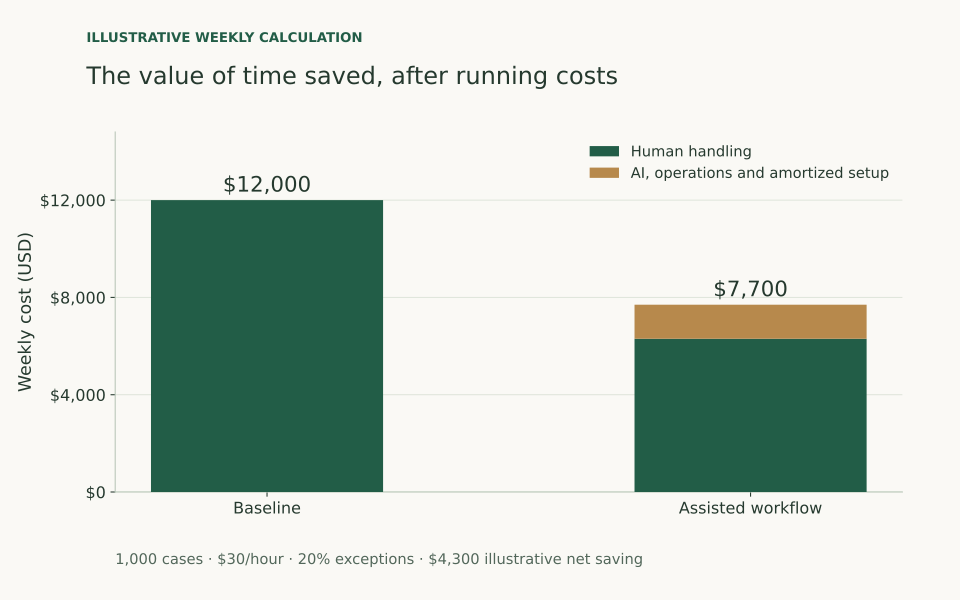
The released hours have an accounting value of in USD. Subtracting the assumed $1,400 weekly cost leaves $4,300 of net weekly benefit.
For this example, define the weekly return relative to the new system’s cost:
That percentage depends on how we account for setup. The $1,400 includes an illustrative $200 for inference, $200 for operations and $1,000 of setup cost allocated to each week. It is neither a vendor price nor a financing calculation. A project proposal should also show the actual upfront outlay, allocation period and payback date.
Most importantly, capacity is not automatically cash savings. If payroll stays the same, the immediate gain may be the ability to handle more volume, clear a backlog or avoid additional hiring. Cash savings require an actual change in expenditure. Describe which benefit is expected and who can realize it.
Routine paths make good demonstrations. Exceptions often determine the business case.
Keep the same seven-minute routine path and thirty-five-minute exception path. Increasing the exception share from 20% to 40% changes average handling time from 12.6 to 18.2 minutes. The capacity ratio falls from about 1.90 to 1.32. The model can be equally fast in both situations; the surrounding process produces a different result.
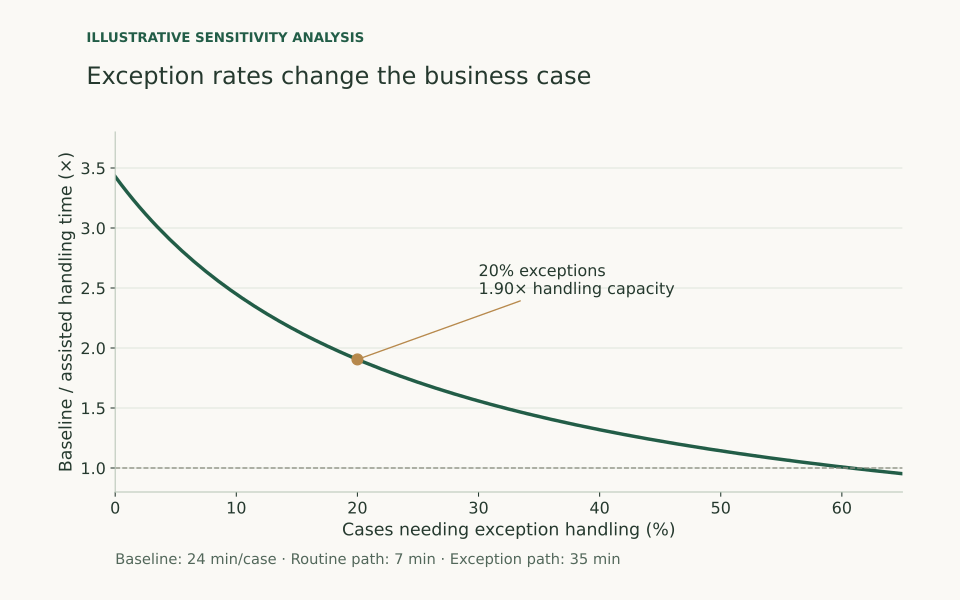
In the financial example, $1,400 spread over 1,000 cases is $1.40 per case. At $0.50 per labor minute, this is equivalent to another 2.8 minutes. Cost breaks even when , or at roughly 50.7% exceptions, under these assumptions. That threshold is a useful question for a pilot: can the proposed workflow stay comfortably below it while meeting its quality requirements?
Time saved on an incorrect result is not a completed benefit. Track accepted completion, reopened cases, incorrect downstream changes and the severity of errors. Record review effort even when the reviewer accepts the first suggestion.
A 2025 METR randomized study illustrates why measurement matters. In its specific setting—16 experienced open-source developers working on 246 tasks—access to the studied AI tools increased completion time by 19%. This is evidence about that experiment, not a forecast for invoice processing or every later model. [1]
METR’s February 2026 follow-up also matters: the researchers reported selection effects that made their newer productivity estimates unreliable. A changing model landscape and a changing participant pool can complicate comparison. [2]
For a business pilot, randomly assign comparable cases where feasible, or use a carefully matched comparison group. Keep seasonal volume, case complexity and staffing differences visible. Report the sample size and an interval around the estimated improvement. A single average without its variation can conceal an expensive tail of repairs.
Suppose an approval queue holds an average of 36 cases and completes eight per hour. For a stable system, Little’s Law relates average work in progress , throughput and time in the system : [3]
This is a relationship between long-run averages, with a consistent system boundary. It does not assume that every case waits exactly four and a half hours. Nor does it tell us that reducing model latency will increase the queue’s completion rate.
If a person approves the queue only twice daily, a faster drafting step may do little for elapsed cycle time. Moving the approval point, changing staffing or improving the information attached to each request may be the more valuable intervention.
Before deployment, agree on the minimum acceptable quality, the cost ceiling and the rollback conditions. The NIST Generative AI Profile is a useful reference for treating evaluation and monitoring as ongoing work rather than a launch-day exercise. [4]
A useful pilot report should let an operations lead answer: How many cases finished correctly? How much human work remained? Which cases became harder? What changed in expenditure or usable capacity?
Those answers support a defensible improvement claim. A multiplication sign belongs in the headline only after its numerator, denominator and scope are clear.
Joel Becker, Nate Rush, Beth Barnes and David Rein · METR · 2025
Back to textJoel Becker and colleagues · METR · 2026
Back to textA practical research-to-CRM workflow with field-level evidence, controlled updates and an honest distinction between faster preparation and better sales outcomes.
Read the article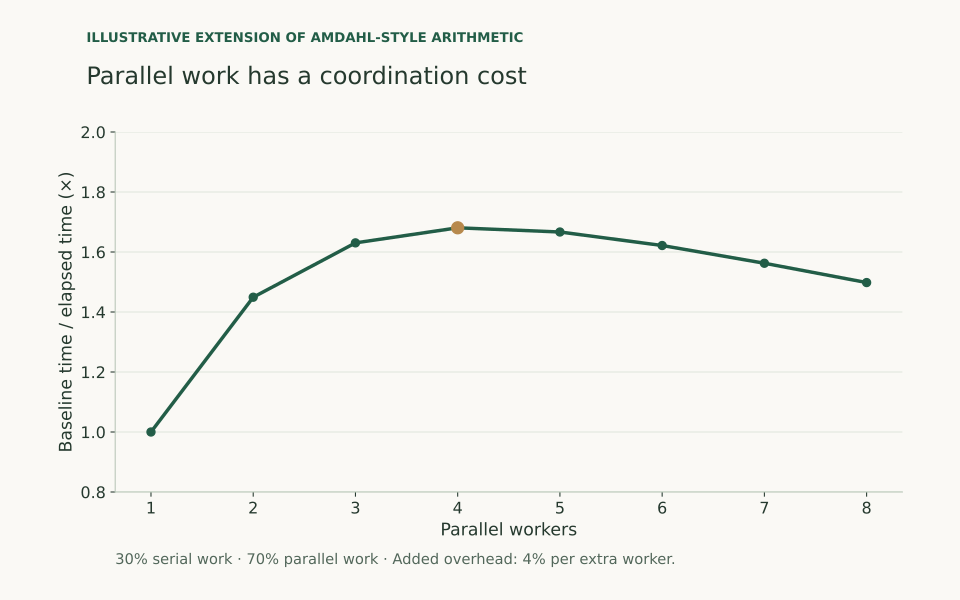
How to identify genuinely parallel agent work, budget coordination overhead and keep evidence, verification and external actions under clear ownership.
Read the article