Private Enterprise AI: Data Isolation, Model Ownership and Deployment Choices
SAMVIT Labs Research·7 min read
Engineering/Engineering guide
A practical guide to where enterprise AI data travels, how identity and authorization should constrain it, and what deployment ownership actually means.
On this page
ABOUT THE EVIDENCEThe architecture is a design example. The confidence chart is a mathematical illustration, not a SAMVIT Labs security assessment or a claim of certification.
A company can run a language model on its own server and still expose the wrong document to the wrong employee. It can also keep inference private while sending prompts, traces or retrieved text to a separate logging service.
The deployment location is one part of the design. The more useful question is: which identity can send which information through which component, and for how long does that information remain available?
Answering that question requires a data-flow diagram, an authorization model and operating procedures. A statement that a model is private does not supply those details by itself.
Draw the full data path
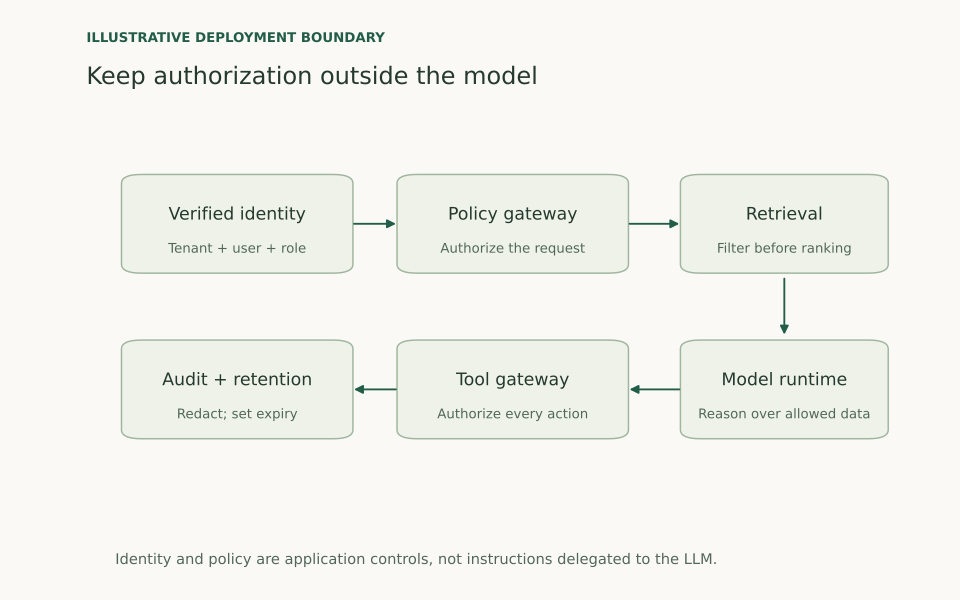
Start with one ordinary request. An employee asks for a summary of a supplier agreement. Follow the request through identity verification, document retrieval, inference, any tool calls and the final response.
Then add the supporting systems: document ingestion, embeddings, caches, telemetry, backups and evaluation datasets. An embedding is a numerical representation used to retrieve relevant content. It remains part of the information lifecycle and needs appropriate access and retention controls.
For each stage, record the operator, the storage location, the identities permitted to access it and the deletion behavior. Include failures and support access. A service that sends a failed prompt to an error tracker has created another copy of the data, even if the normal inference path keeps everything on premises.
Figure 1. An illustrative control path. Authorization is enforced by the application and connected services. The language model reasons over information that those controls permit it to receive.
A diagram is useful when someone can point to every arrow and explain its purpose. If an arrow crosses a supplier boundary, that boundary belongs in the deployment discussion.
Bind identity before retrieving information
A retrieval-augmented application often searches documents and places selected passages into the model’s context. Authorization has to constrain that search before unauthorized material can enter the prompt.
The application should obtain a tenant and user identity from a verified session. A tenant is the organization or customer boundary within a shared service. Tenant identity supplied as ordinary chat text is not a reliable access-control input.
NIST’s zero-trust architecture provides a relevant starting point: network location and asset ownership do not automatically establish trust. Authentication and authorization remain explicit decisions around access to resources. That principle applies inside a private AI deployment as well. [1]
In a shared retrieval service, possible controls include separate indexes, database row-level policies and mandatory tenant filters applied by trusted server code. The choice depends on the storage engine and isolation requirements. Test the actual implementation; a filter field appearing in a request is not evidence that the storage layer enforced it.
Watch the cache boundary too. If a cached answer depends on a user’s permissions, a key based only on the question can be insufficient. Permission changes and document deletion may also require cache invalidation.
Treat documents as information, not authority
A supplier agreement, email or retrieved web page can contain instructions addressed to an AI system. Those instructions arrive as document content. They should not grant new permissions or change the application’s policy.
OWASP describes indirect prompt injection as a risk arising when an application accepts external material that can influence model behavior. Retrieval and fine-tuning do not fully eliminate that class of problem. Controls around data access, tool permissions and output handling therefore remain important. [2]
For example, a document-summary assistant may need read access to approved contracts. It does not automatically need permission to email their contents to an arbitrary address. A tool gateway can check the requested action, destination and verified user entitlement before allowing a side effect.
A private server reduces some external dependencies. It does not make the contents of every document trustworthy. Keep the same identity and action boundaries when moving between hosted and privately operated models.
Separate model ownership from data control
The phrase proprietary model can describe several arrangements. A company might train model weights, adapt licensed base weights, maintain private adapters or own the application and its evaluation data. Those are different assets.
A deployment review should name them separately. Which base-model license applies? Who controls checkpoints and adapters? Who can export them? Which data may be used for training, and which is available only during an individual request? These questions require the actual contracts and licenses; architecture alone does not settle ownership.
The same distinction helps compare hosting arrangements:
Deployment choice
Practical advantage to evaluate
Responsibility that remains
On-premises infrastructure
Direct control over local hardware and network paths
Patching, capacity, backups and access policy
Private cloud environment
Dedicated configuration and cloud operating tools
Cloud identity, service permissions and data flows
Hybrid deployment
Different workloads can use different environments
Boundary enforcement and consistent audit records
None of these rows is a compliance conclusion. The appropriate option depends on the information involved, operational capabilities and obligations of the organization.
Test isolation with a defined experiment
A useful test asks a concrete question: can an identity retrieve a document it is not entitled to access? Build cases across tenants, roles, revoked memberships, stale caches and deleted documents. Include attempts that use document titles or paraphrases rather than only exact text.
Track unauthorized retrievals, unauthorized tool actions and incomplete deletion separately. Combining them into one average can hide a serious failure in a less common path. Preserve enough trace information to locate the failed boundary without unnecessarily storing sensitive raw content.
A report of zero failures also needs a denominator and a sampling method. Confidence intervals for proportions provide useful background on why a sample rate is not the same as a guaranteed population rate. [3]
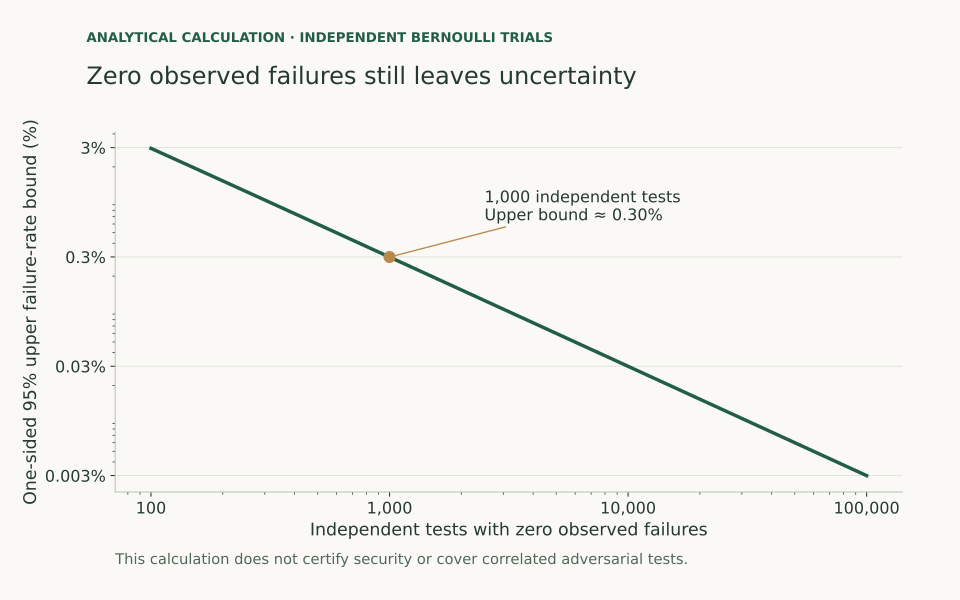
For a simple mathematical illustration, suppose n independent tests each have the same unknown failure probability p. The probability of seeing zero failures is:
P(0 failures∣p)=(1−p)n
Setting that probability to 0.05 gives a one-sided 95% upper bound after zero observed failures:
pupper=1−0.051/n≈n3
With 1,000 such tests, the upper bound is approximately 0.30%. The approximation is often called the rule of three. The exact expression above is the calculation used in the figure.
Figure 2. An analytical binomial calculation under independence and a constant failure probability. Security tests are often correlated or deliberately adversarial, so this curve cannot certify a deployment. Download the calculation data.
The assumptions matter more than the attractive curve. Repeating the same easy query a thousand times is not equivalent to testing a thousand meaningfully different access paths. A newly discovered attack can invalidate the relevance of an earlier sample. Use statistical reporting alongside architecture review and adversarial evaluation, not as a replacement for them.
Operate the lifecycle after launch
Access rights change. Documents expire. Models and retrieval indexes are replaced. Every change can affect an earlier isolation decision.
Define how a deleted source document propagates through indexes, derived artifacts, caches and backups. Decide which logs need raw text, which can use redacted fields and when each class expires. Record the difference between immediate removal from active retrieval and eventual expiry from an approved backup policy.
The NIST Generative AI Profile is useful for organizing ongoing evaluation and information risks. It is guidance, not a certification badge for a system that cites it. [4]
An operational review should have a named owner for identity policy, a process for reviewing tool access and a way to investigate unexpected information exposure. These responsibilities apply to a small language model just as they do to a much larger one.
A well-specified private deployment lets the team explain the data path without relying on the model to protect it. That explanation should survive a change of model vendor, hardware or hosting environment. The boundaries are part of the application.
The SAMVIT Labs research and engineering journal. We examine model efficiency, practical agent workflows and the evidence needed to make informed deployment decisions.